Education in Volunteering

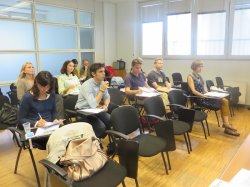
The Platform has also been active for a long time in the field of education and the development of key skills in the field of volunteering. It offers a number of training programmes aimed at improving the quality of volunteer management, bringing together experts and professionals who have been involved in the practice, theory and legislation of volunteering for many years. 

The Platform has recently expanded its offer to include online courses, making them even more accessible to anyone in Slovakia. The content corresponds to the scope of classical face-to-face trainings, while also including personal consultations.

Individual courses are opened by the Platform to the general public, while private courses are also available for schools, organisations or institutions.

The trainings are supported by a grant from the Ministry of Education, Science, Research and Sport of the Slovak Republic, administered by IUVENTA - Slovak Youth Institute.


Current trainings on offer:

Management of volunteers

32-hour accredited training, divided into 4 days.  Successful graduates of the course receive a certificate of completion of training accredited by the Ministry of Education of the Slovak Republic.

The training is intended for workers and volunteers in non-governmental and public organisations (civic associations, non-profit organisations, social welfare institutions, schools, foundations, etc.) who already work with volunteers or plan to include them in their activities. It is designed for people who want to learn and share with others how to find, select, train, motivate and retain volunteers. The training provides relevant theoretical and practical knowledge, skills and concrete methods that will be applicable when working with volunteers. It creates opportunities for role-plays, experiential techniques and their reflection for working with volunteers, interactive group work and exchange of experiences during discussions. The final exam includes the submission of a written elaboration of the volunteer programme manual/guidelines.


Service-learning in the education and training of children and young people for volunteering

The aim of the 24-hour accredited training programme divided into 3 days is to develop and expand the knowledge and skills of youth workers and pedagogical and professional staff of schools and educational institutions in the implementation of education and training of children and young people for volunteering through the strategy of service-learning in accordance with the Concept of Education and Training of Children and Youth for Volunteering (2018). 

Service-learning is a teaching and learning strategy that combines meaningful volunteer service in the community with education and reflection. It is a way of learning in which theoretical training is linked to practical experience. The added value of service-learning is that it allows one to help others in their natural environment in addition to your own development. 

The target group is people working with children and young people in formal and non-formal education - youth workers (both voluntary and paid), pedagogical and professional staff and employees: teachers of whatsoever subject in kindergartens, primary and secondary schools, craftsmen and women teaching vocational training, educators and tutors. Participants are expected to have an interest in and a positive attitude towards the topic of volunteering. 

Successful graduates of the training receive a certificate of completion accredited by the Ministry of Education of the Slovak Republic. The training also includes a final exam consisting of a presentation of a plan for the implementation of education and training for volunteering through the service-learning method in a particular school or organisation.


Measuring and communicating the impact of volunteering

The aim of this 16-hour training is to develop participants' knowledge and skills in measuring and communicating the impact of volunteering. The training is aimed at volunteer coordinators and youth workers working on the topic of the impact of volunteering, people working in NGOs, as well as in local and national government who want to: 

  • demonstrate the benefits of their volunteering programme for different target groups,
  • be able to collect relevant quantitative data and interpret qualitative evaluations in relation to the results of the volunteering programme, 
  • improve their volunteering programmes based on a qualitative evaluation of their current performance,
  • communicate the impact of the volunteering programme convincingly to the public, partners or donors.


Managing young and disadvantaged volunteers

Training of 15 hours, divided into several blocks. Participants will gain skills in communication with young people with disabilities, learn about the specifics of the appropriate work environment and appropriate working relationships when working with young people with disabilities, be able to set and identify an appropriate strategy for working with this target group, appropriate volunteer positions and benefits of volunteering, and be proficient in the elements of management of working with volunteers with disabilities. 

The training is intended for persons working or interested in working with young volunteers with disabilities in public administration, in NGOs, in religious organisations in various fields - social, environmental, cultural, children and youth work, education, human rights, etc.

Awards for volunteers

The Heart in the Palm of Your Hand - Volunteer Award is an award dedicated to exceptional people - volunteers, as well as to exceptional volunteer projects. It is an award with a tradition of more than twenty years, which takes place on the occasion of the International Day of Volunteers (5 December) as well as the International Day of Coordinators of Volunteers (5 November).

The award is for those who volunteer their time and energy, without financial reward, to people in need, as well as to great ideas and exceptional projects that make our world a more beautiful and more compassionate place.

The award is given at the regional level as well as at the national level, where it is presented at the Volunteer of the Year event.

The regional awards are usually organised by the regional volunteer centres, which usually present the awards to the most outstanding volunteers at the end of the year in a festive atmosphere in the regional towns across Slovakia.

Since 2018, Martin Giertl, Plenipotentiary of the Slovak Government Office for the Development of Civil Society, has taken over the patronage of these events in the regions.


National awards

Since 2008, the Volunteer of the Year Award has been organised by the National Volunteer Association. The awards are organised at the national level by CARDO - National Volunteer Centre and from 2020 also in cooperation with the Platform of Volunteer Centres and Organisations and regional volunteer centres.

The Volunteer of the Year event is held under the auspices of the Minister of Foreign and European Affairs of the Slovak Republic.


The Platform's place in the awards

Since 2018, the Platform of Volunteer Centres and Organisations has been supporting the Volunteer Centres and their regional Heart in the Palm of Your Hand award campaigns by collaborating on promotion. For this purpose, we have created the website www.srdcenadlani.sk, which provides comprehensive information about the award, its history, as well as the award winners themselves in the regions active in the award. It aims to provide all relevant and continuously updated information in one place.


This project was supported by the grant of the Ministry of Education, Science, Research and Sport "Programmes for Youth 2014 - 2020", administered by IUVENTA - Slovak Youth Institute.


Engaged Schools

The Platform of Volunteer Centres and Organisations runs a national award called Engaged Schools for schools implementing service-learning activities.

The award is aimed at highlighting and rewarding the work of kindergartens, primary and secondary schools that implement volunteer projects aimed at serving the community in conjunction with educational objectives and promoting active citizenship of youth through the service-learning method.

Service-learning is a teaching and learning strategy that combines meaningful volunteer service in the community with education and reflection. Theoretical training in schools is linked to the acquisition of practical experience. The added value of service-learning is that it allows one to help others in their natural environment in addition to your own development.

This is the first award of its kind to raise the profile and highlight the importance of the work of educational institutions using the service-learning method to promote the involvement of pupils in civil society activities. 

The award is intended to highlight the role of the school as an institution that not only imparts academic content, but prepares young people to participate in the democratic life of society by encouraging participation in improving the quality of life of the community and society.

The winners of the national rounds are nominated for awards at the level of Central and Eastern Europe for the so-called Regional Award for Successful Service-Learning Practice in Central and Eastern Europe. 

The purpose of the award is:

  • to collect examples of good practice in the application of service-learning in education enabling young people to expand their knowledge horizons and actively participate in the transformation of their communities;
  • to highlight the contribution of schools that link educational content with finding and implementing solutions to community needs;
  • to raise the profile of educators who enhance the quality of education of their pupils towards social transformation of the community; and to raise the profile of pupils who are active citizens;
  • to promote a culture of active citizenship and solidarity

We know that quality education is not only about the transmission of academic content, but also requires that pupils are better educated: democratically and with a focus on the quality of life in the community.

The National Awards are organised by the Platform of Voluntary Centres and Organisations under the auspices of the Ministry of Education, Science, Research and Sport.

The international award is also co-organised by the international organisation Interactive Open Schools (hereafter MIOS) and the partners of the Service-Learning Network for Central and Eastern Europe (CEE SL Network) with the support of the Latin American Service-Learning Centre (CLAYSS).

The winners of the international award will also receive a cash prize to be used for another service-learning project in their community. The 1st place award is $1,000, 2nd place is $ 750, and 3rd place is $ 500.

Advocacy of volunteering

Advocacy is carried out through representation in the Government Council for Non-Governmental Non-Profit Organisations, through membership and active participation in the activities of the European Volunteer Centre, but also through specific activities; in recent years in particular:

  • Coordination and cooperation with 20 organisations in the preparation of the Concept of Education and Training of Children and Youth for Volunteering (adopted in April 2018).
  • Collaboration with more than 10 organisations in the development of the Youth Report on Volunteering (2018).
  • Cooperation in the preparation of a proposal for cooperation between labour, social affairs and family offices and volunteer centres in the field of volunteering for the unemployed.
  • Working meetings with representatives of the Office of the Government Plenipotentiary for the Development of Civil Society on the topic of volunteering legislation.
  • Working meetings with MPs of the National Council of the Slovak Republic on legislative support for volunteering.
  • Cooperation on the preparation of the proposal and implementation of research on the non-profit sector and civil society, which includes the topic of research on volunteering.
  • Cooperation on the preparation of the Youth Strategy 2021-2028.
  • Coordinating the development of quality standards for youth work.
  • We participated in the working meetings of the steering group at Iuventa and the Ministry of Education, Science, Research and Sport where we commented on the content of the new legislation for the support of youth work.
  • The Platform of Volunteer Centres and Organisations coordinated the preparation of the current Youth Strategy for Youth Volunteering and the preparation of the Programme for the Development of Volunteering and Volunteer Centres in Slovakia.  Currently, we are again members of the working group preparing the new Youth Strategy for 2021-2028.
  • Thanks to the Platform of Volunteer Centres and Organisations, the position of volunteer coordinator is part of the national occupational framework.
  • We co-organised the Orbis Civitates conference (October 2019), which is dedicated to current issues in the non-profit sector, with special attention to the topic of volunteering and philanthropy, which we professionally guaranteed.
  • Platform of Volunteer Centres and Organisations members were behind the drafting of the Law on Volunteering and have since been actively involved in the development of legislation in the field of volunteering. In December 2016, we prepared the document "Development of volunteering in Slovakia: interests and needs of voluntary organisations and centres. Document for the Government and Parliament of the Slovak Republic."  The document defines the priority topics for which the Platform of Volunteer Centres and Organisations is actively seeking support from MPs and the public administration. 1) Introduction of an internationally valid method of measuring volunteering and the economic value of volunteering, 2) Legislative regulation of volunteering in Slovakia, and 3) Education and training for volunteering in kindergartens, primary, secondary and higher education.
  • Thanks to Platform of Volunteer Centres and Organisation's close cooperation with the Office of the Government Plenipotentiary for the Development of Civil Society, two tasks related to the promotion of financial support and favourable legislation in the field of volunteering were included in the Action Plan of the Concept for the Development of Civil Society for 2019 and 2020: task B.9. - to prepare a proposal for a mechanism of direct state support for volunteer programmes in order to promote volunteering in different areas, and task B.10. - to analyse the need for legislative amendments to Act No. 406/2011 Coll. on Volunteering and on Amendments and Additions to Certain Acts, as well as to identify the need for amendments to other legislation. On the basis of the analysis, prepare a proposal for legislative amendments to Act No 406/2011 Coll. on Volunteering and on Amendments and Additions to Certain Acts, as well as proposals for amendments to related legislation and submit them to the Government of the Slovak Republic for discussion. For these tasks, a working group is currently being established, which will be coordinated by the Platform of Volunteer Centres and Organisations in cooperation with the Office of the Government Plenipotentiary for the Development of Civil Society.

VSkills for Employment

V-Skills for Employment is an online tool we have developed volunteers can use to:

  • realise,
  • name,
  • record
  • and demonstrate the competencies or skills they have acquired or developed during their volunteering.


They support their assessment with photographs, videos, documents or other outputs and outcomes of their volunteering.

The questionnaire will be verified by the volunteer coordinator(s) in the organisation where the activity was carried out.

The acquired competencies will be confirmed by a committee at the Matej Bel University in Banská Bystrica and together with the Platform of Volunteer Centres and Organisations the volunteer will be issued with a certificate stating these competencies.

The certificate will be attached to the CV of the volunteer and/or the competencies will be directly mentioned in the CV among the work or volunteer experience.

The verified competencies will assist employers in selecting new employees for their company.

The online system V-Skills for Employment is one of the main outputs of the VOLWEM - Volunteering as Way to Employment project. The project was implemented between October 2012 and September 2014 thanks to the support of the European Commission.

Quality Brand

The Quality Brand "We can do it with volunteers" shows that the organisation works well with volunteers and understands volunteering.

It is the trademark or evaluation of an organisation based on the validation of the methods it uses when working with volunteers. The Quality Brand is awarded to organisations by the Volunteer Centres and Organisations Platform after reviewing specific practices in managing volunteers and reviewing evidence of their application, using the so-called Quality Standards.

The standards focus on the following areas of work with volunteers:

  • Coordination of volunteers
  • Legal and ethical framework
  • Financial and material resources for volunteering
  • Integration into the team
  • Job description and profile of volunteers
  • Recruitment and selection of volunteers
  • Training and preparation of volunteers
  • Communicating with and supporting volunteers
  • Awards and recognition
  • Recording, documentation, evaluation of the volunteer programme

An organisation can obtain the Quality Brand by going through a specified process of self-assessment and external evaluation by trained assessors. It has 3 levels and is awarded for three years. 

An organisation can receive one, two or three stars, which refer to the quality level of volunteer management. The more stars, the better the management system the organisation has set up.

The awarded Quality Brand is intended to guarantee prospective volunteers that the decision to volunteer with the organisation that holds it will not lead to disappointment with the organisation's approach to volunteers. 

Obtaining the Quality Brand is a signal to potential volunteers or the public who might be interested in volunteering with the organisation that the organisation recognises the immeasurable value of the work of volunteers, cares about them, wants them to feel good about the organisation, wants to look after them and treat them fairly. It is also a signal to donors that the organisation works well with volunteers and can be a strong partner for them.

The Platform of Volunteer Centres and Organisations provides a 10% discount on its education, trainings or workshops to holders of the Quality Brand.

Benefits in foundation grant programmes.
The following foundations also ask about the Quality Brand on their grant application forms:


The Quality Brand has also become part of the volunteer offers of the regional volunteer centres. 

This project was supported by the grant of the Ministry of Education, Science, Research and Sport of the Slovak Republic "Programmes for Youth 2014 - 2020", administered by IUVENTA - Slovak Youth Institute.


VOLWEM

resized__150x33_VOLWEM


VOLWEM Project

(Volunteering – Way to Employment)

Three CEV members - The Platform of Volunteer Centres and Organisations in SlovakiaVolunteer Development Scotland and Volunteer Centre in Usti nad Labem in Czech Republichas started a two year project (October 2012 – September 2013) under Leonardo da Vinci – Transfer of Innovation scheme. There are 5 more partners from Slovakia including Matej Bel University and four regional volunteer centres involved. Main objective of VOLWEM is to transfer two systems of work with (unemployed) volunteers from the UK and Czech republic to Slovakia in order to help them to recognize the skills gained in volunteering within the labour market and thus raise their employability.

The projects activities were as follows:


  • Provide Slovak volunteers with an online tool to help them enhance their prospects in seeking an employment by capturing their learning gained through their volunteer activities. The online tool – V-Skills for Employment (UK) is focused on the recognition of skills and competencies gained through volunteering – the evidence confirming the existence of these skills and competencies is collected by a volunteer himself with the support of a volunteer centre or volunteer involving organization and consequently certified by a special committee based on a college.
  • Provide professionals at labour offices and volunteer centres with a method which enables them to involve unemployed people in volunteering. This system of work called Welcome (Czech republic) is focused on volunteer centres, volunteer involving organizations, labour offices and unemployed people and its goal is to create conditions supporting the involvement of unemployed people into volunteering.
  • Make employers aware about the competencies gained through volunteering and make them recognize these skills in the process of recruitment.
  • Provide a results study of this project for institutions of formal learning, for employers, public institutions as labour offices and Ministry of Work, Family and Social Affairs in Slovakia.


Benefits of Volunteering for Unemployed People


Alžbeta Brozmanová Gregorová has worked on the final result of this project – Benefits of Volunteering for Unemployed People – VOLWEM Project . Based on the analysis of competence questionnaires and online tool D-zručnosti pre zamestnanie we can state that for unemployed people volunteering created a space for the development of specific skills, knowledge, and attitudes and thus contributed to the development of their employability


Through volunteering, the unemployed volunteers improved their ability to work in demanding and difficult situations, to make decisions, to handle stress, to work in team, to cooperate with others on solution of problems and conflicts. In the area of communication competences, the largest progress was documented in the area of development of the ability to participate in discussions, to express one´s own opinion, to actively listen to others and the development of presentation skills. Among the most developed competences related to employment and entrepreneurship we can mention these: time management, ability to lead other people, to orientate in a new working environment, skills related to project management, and creativity. In the area of social and personal competences, the largest progress reached thanks to volunteering was documented in ability to work in team, self-respect and self-confidence, and self-management of people. For a larger group of unemployed people, volunteering also created a space for improvements of the PC and Internet skills.


Other benefits prove that for unemployed people volunteering creates a space for:


  • the development of social contacts,
  • the change of attitude toward work and the acquirement of working habits,
  • the change in personal development and change in life and the life direction,
  • the feeling of personal satisfaction,
  • the change of views on various topics and issues,
  • the development of specific abilities and skills,
  • the development of knowledge on various target groups,
  • the change of opinions and attitudes related to various target groups,
  • the acquirement and development of specific skills related to work with various target groups,
  • the change of views on volunteering and NGOs.


46 out of 65 (more than 70 %) unemployed volunteers stated in the Competence questionnaires that they will name this experience in their CV. More than 90 % of the unemployed volunteers use or will use the experience in their personal and professional lives.

Benefits of Volunteering for Unemployed People – VOLWEM Project Publication can be found here.


EU_flag_LLP_EN_01

This project has been funded with support from the European Commission. This publication [communication] reflects the views only of the author, and the Commission cannot be held responsible for any use which may be made of the information contained therein.

Volunteering – a Way for Activity in Senior Age

During the year 2014, we carried out a senior volunteering exchange together with our partner organization RADKA from Czech Republic.

The implementation of volunteering exchanges of seniors is often limited by a language barrier. Many seniors are worried to travel to another country for a longer time if they do not speak the language and the language barrier is very limiting also for the selection of volunteering activities these people can be involved into.

In the case of Czech – Slovak exchange, this barrier does not almost exist and it opens a space  to seniors who do not speak any foreign language.

SDC10861_800x600

 Both partner organizations focused on unemployed people of the age 50+ and we involved them into activities in culture, social and health care (Mother-kids centres, hospitals, senior homes, leisure time activities for children and youth, work with disabled people).

The goal of the project was to support the life-long learning through volunteering and to provide senior volunteers with experience relevant for people over 50 who are currently unemployed.

There were 6 volunteers from Czech Republic who were sent to Slovakia and vice versa, all of them stayed in the other country for 4 weeks. Volunteers were sent in a group and in the hosting country, they volunteered for several organizations (in Slovakia they were placed in the Platform of Volunteer Centres and Organisations, senior home Hestia, day care center for homeless people DOMEC, and Nitra Volunteer Centre).

In the Czech republic, they were hosted by one organization but participated in different volunteer programs (mothers center, senior home, and a nursery Raduška).

Another goal of the project is to support positive relationships between Slovak and Czech citizens.


resized__150x58_EU_flag_LLP_EN_01

This project has been funded with support from the European Commission. This publication [communication] reflects the views only of the author, and the Commission cannot be held responsible for any use which may be made of the information contained therein.

VTI Project

In fall 2013, we started to implement the VTI Project (Volunteering as a Tool for Inclusion). It was an international project with the overall aim to increase the social inclusion of disadvantaged and marginalised groups through volunteering in partner countries and to share already existing experience/practices/tools in the field.

The Platform acted as a coordinator for this project in cooperation with seven other partners:


•    Volunteer Ireland

•    Frivilligcentre og Selvhjælp Danmark (FriSe)

•    ÖKA – National Volunteer Centre, Hungary

•    Volunteer Centre Osijek, Croatia

•    PRO VOBIS – National Volunteer Centre, Romania

•    brīvprātīgais.lv, Latvia

•    Vol.To, Italy


Project Objectives:

1.    To share experience among partner countries on how to involve people from vulnerable groups into volunteering.

2.    To create recommendations for volunteer coordinators for cooperation with different groups of vulnerable volunteers (people with hearing and visual impairment, migrants, seniors, people with mental health difficulties, etc.). Recommendations for volunteer coordinators on how to develop a more inclusive volunteer programme

3.    To collect and publish good examples from partner countries that can serve as an inspiration for other volunteer centres and volunteer involving organizations.

Time Frame: August 2013 – July 2015

resized__250x187_IMG_1777

During the project run, the partners were participating at international meetings organized in each partner country. The goal of these meetings was to share various good examples of involvement of people with disabilities or disadvantaged groups into volunteering but also to work together on project products (Collection of Good Examples and Recommendations for Volunteer Coordinators on how to work with marginalized groups in volunteering).


Meetings were held in this order:


•    The first meeting took place in Bratislava on November 14 – 15, 2013

•    The second meeting of partners was organized on March 6 – 7, 2014 in Dublin, Ireland

•    The third session was held in Copenhagen, Denmark on June 26 – 27, 2014

•    The fourth one was implemented from September 30 till October 1, 2014 in Turin, Italy

•    The fifth meeting was organized by Hungarian colleagues in Budapest on January 22 – 23, 2015

•    The sixth time the project partners met in Cluj-Napoca, Romania on March 12 – 13, 2015

•    The seventh meeting took place on April 22 – 23, 2015 in Zadar, Croatia

•    The last meeting of this partnership happened on June 18 – 19, 2015 in Riga, Latvia


Partnership that was formed thanks to this project was functioning really well and in addition to precious experience and valuable products, it was also a basis for new personal friendships and future cooperation. We hope that the project results will support volunteer involving organizations to be more open, they will convince them that everybody can participate in volunteering and will provide them with information that can help them to overcome their fear of hesitance of engaging people with disabilities or from marginalized groups into volunteering.


resized__150x58_EU_flag_LLP_EN_01

This project has been funded with support from the European Commission. This publication [communication] reflects the views only of the author, and the Commission cannot be held responsible for any use which may be made of the information contained therein.

Promoting volunteering to the unemployed

In the process of dealing with their situation, jobseekers encounter offers from the Labour Offices to participate in various activities or projects that are supposed to bring them new experiences, personality development or competencies that can increase their chances of finding a job on the labour market.

Volunteering is seen as a tool that leads to the above and therefore may be a suitable tool for some job seekers to meet some of their needs whilst unemployed.

Our first experience with the involvement of registered job seekers dates back to 2012-2014, when we implemented the VOLWEM project. One of its outputs was the creation of a tool to measure the development of competencies acquired through volunteering. You can read more about D-skills for employment HERE.

On the basis of our own experience, as well as foreign studies confirming the positive impact of volunteering on people, we established cooperation with the Centre for Labour, Social Affairs and Family. Through the individual Labour Offices, we announce the opportunity for volunteering to potential individuals among registered job seekers interested in volunteering.

The aim is to:

  1. inform about the nature of volunteering as defined by the Volunteering Act.
  2. provide interested persons with contacts to regional volunteer centres.
  3. provide information on available volunteering opportunities in the regions of Slovakia.
  4. present D-skills as a tool for verification of acquired competencies
  5. present the "With volunteers and we know" Quality Brand as a tool to identify a professional organisation.

Those interested in volunteering can find all the information and contacts to the regional centres on the website WWW.DOBROVOLNICTVO.COM

These activities are supported by the grant of the Ministry of Education, Science, Research and Sport of the Slovak Republic "Programmes for Youth 2014 - 2020", which is administered by IUVENTA - Slovak Youth Institute.